

Register client-side callbacks
Use client-side callbacks for operations that belong to the current page, such as navigation or updating in-memory application state.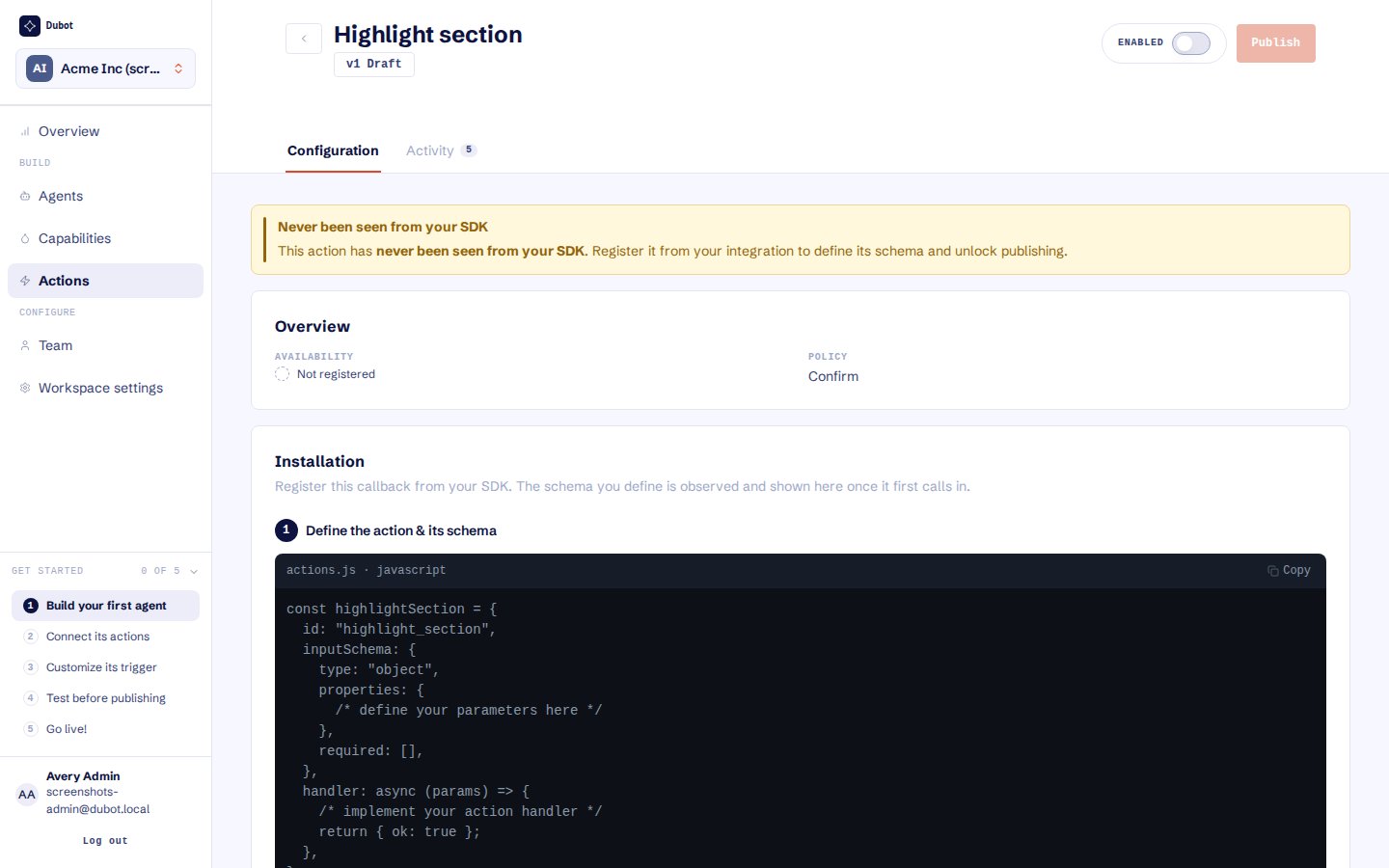
Publishing stays unavailable until the host registers the callback and its input schema appears in Dubot.
Replace callbacks when page state changes
setActions() uses full-set replacement semantics. Pass every callback that should be available
after the call.
Execute Session API actions
The customer-owned Session API executor is currently delivered and reviewed during integration;
it is not yet a stable self-service public API. Confirm its request and registry contract with
Dubot before implementing the first authenticated operation.
Confirmation and outcomes
Every action has anauto or confirm execution policy.
- Chat-originated confirms render in the wizard.
- End-user MCP confirms render in the page action toast.
- A decline returns a declined outcome without invoking the operation.
- Errors return a bounded failure result and appear in action activity.
- Response masks limit which returned fields reach the assistant.
Resource Center callbacks are separate
A static Resource Center card can run a host callback without advertising that callback as an assistant tool:resourceCenterCallbacks and actions are intentionally separate registries.